
Real-Time Translation for E-Commerce: How to Enter the Global Market
Analytical guide to international e-commerce expansion using AI translation: market statistics, impact of language barriers on conversion, and scaling strategies
Key Takeaways:
The cross-border e-commerce market will grow from $551 billion in 2025 to $2 trillion by 2034. Meanwhile, 76% of shoppers prefer products with information in their native language, and 40% will never buy from a website in another language. Companies with multilingual websites see sales increases of 25% to 70%, and every $1 invested in localization returns $25.
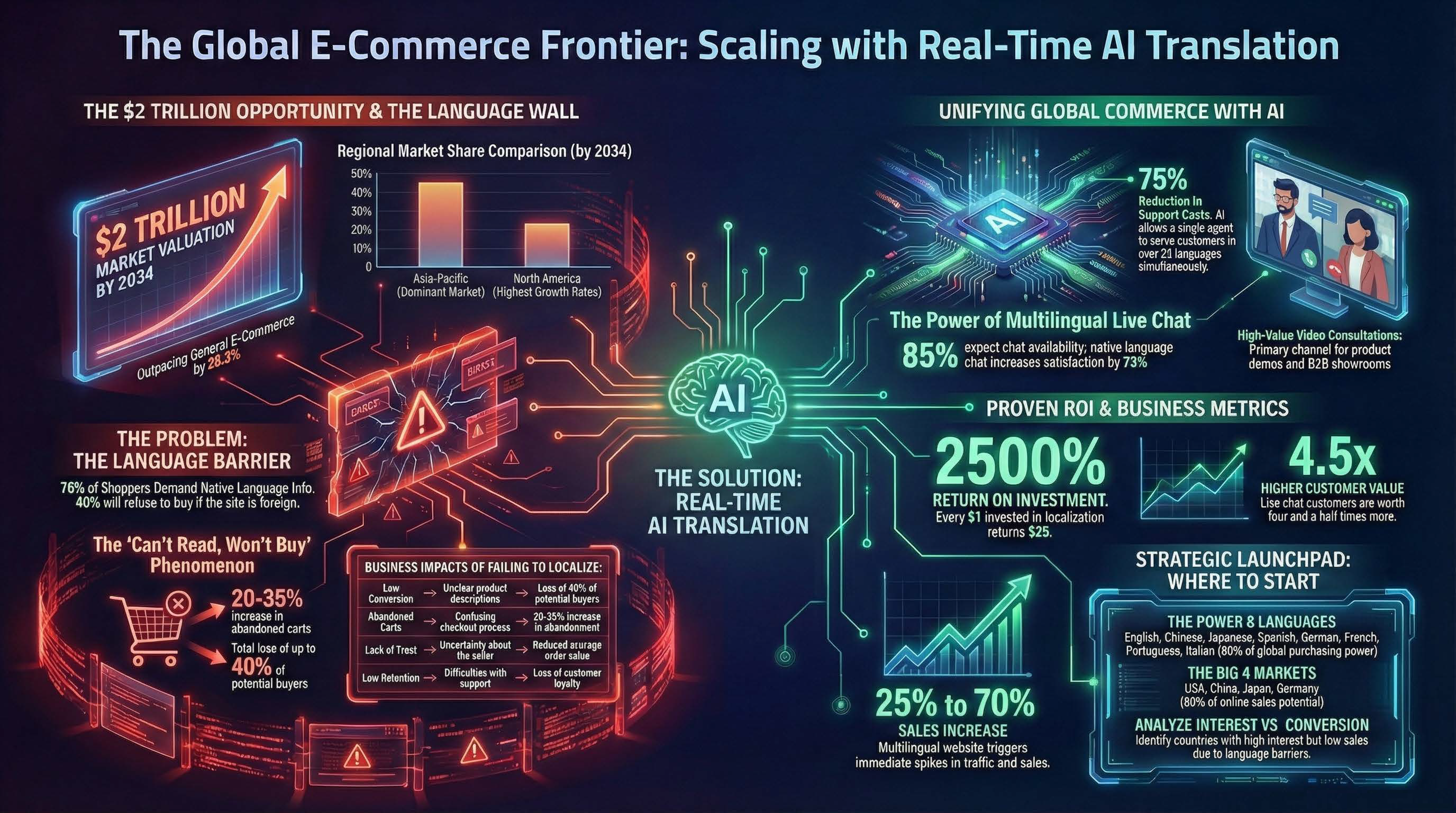
Scale of Opportunity: The Global Cross-Border E-Commerce Market
The global cross-border e-commerce market is experiencing explosive growth. Cross-border trade accounts for approximately 20% of all online sales worldwide and is outpacing overall e-commerce growth by 28.3%.
Sources: Precedence Research, Capital One Shopping
Regional Market Structure
The Asia-Pacific region dominates the cross-border e-commerce market, while North America demonstrates the highest growth rates.
🌏 Asia-Pacific Region
🇺🇸 North America
📱 Mobile Commerce
Sources: Market.us, eMarketer, World Bank
Language Barrier: The Main Obstacle to Global Sales
Despite enormous opportunities, language barriers remain a critical obstacle to international expansion. The CSA Research study "Can't Read, Won't Buy" reveals the scale of the problem.
Source: CSA Research "Can't Read, Won't Buy"
Business Consequences of Language Barriers
| Problem | Business Impact | Financial Consequences |
|---|---|---|
| Low Conversion | Customers don't understand product descriptions | Loss of up to 40% of potential buyers |
| Abandoned Carts | Confusing checkout process | 20-35% increase in abandonment |
| Lack of Trust | Customers unsure about the seller | Reduced average order value |
| Repeat Purchases | Difficulties with support | Loss of customer loyalty |
Why Real-Time AI Translation Is Critical
Traditionally, companies relied on static website translation, but modern e-commerce requires real-time communication: live chats, video consultations, and customer support.
🌐 Live Chat with Translation
85% of customers expect chat on websites. Multilingual chat increases satisfaction by 73%
💰 Support Cost Savings
One agent with AI translation serves 25+ languages, reducing costs by up to 75%
📈 Conversion Growth
Shoppers are 13% more likely to buy from a store in their language, even at higher prices
🎥 Video Consultations
98% of business meetings include remote participants. AI translation removes language barriers
Sources: LiveChat, Askly, Shopify, Cisco Hybrid Work Index
Live Chat: The Maximum Conversion Point
Live chat is one of the most influential tools for increasing e-commerce sales. Statistics show a direct correlation between chat availability and revenue growth.
Sources: Freshworks, ICMI Report, LiveChat
💵 Impact of Live Chat on Business Metrics
Key Metrics:
- ✅ 79% of companies report increased loyalty, sales, and revenue
- ✅ 40% conversion increase after chat implementation
- ✅ 60% of customers will return to a site with live chat
- ✅ Chat customers are worth 4.5x more
Source: Kayako, ICMI
Localization ROI: Investments That Pay Off
Data from multiple studies confirms the economic effectiveness of investing in language adaptation and real-time translation.
⏱️ Long-Term Impact
Localization automation: 345% ROI over 3 years
3/4 of companies see increased engagement
Sources: Onesky.ai, Forrester Consulting, Crowdin
Video Conferencing as a New Sales Channel
The global video conferencing market reached $33 billion in 2024 and continues to grow. For e-commerce, this opens new opportunities for direct customer communication.
| Metric | Value | Source |
|---|---|---|
| Market Size 2024 | $33.04B | Fortune Business Insights |
| Forecast 2032 | $60.17B | Fortune Business Insights |
| CAGR | 7.1% | Fortune Business Insights |
| Meetings with Remote Participants | 98% | Cisco Hybrid Work Index |
| Travel Cost Savings | 30-40% | SQ Magazine |
| AI Integration in Platforms | 60%+ | Cisco Annual Internet Report |
Opportunities for E-Commerce
- Video Consultations with Customers — Real-time product demonstrations
- Supplier Negotiations — Working with international partners
- Distributor Training — Onboarding across different countries
- Virtual Showrooms — Presentations for B2B clients
Practical Steps for Entering the Global Market
1. Market Prioritization
🌍 TOP 8 Languages
English, Chinese, Japanese, Spanish, German, French, Portuguese, Italian = 80% of global purchasing power
🎯 TOP 4 Countries
USA, China, Japan, Germany = 50% of global online sales potential
📊 Traffic Analysis
Use Google Analytics to identify countries with high interest but low conversion
Source: Translated.com
2. Implementing Real-Time Translation
💬 Live Chat with AI Translation
Automatic customer language detection. Real-time translation. One agent — the entire world.
🎥 Video Consultations
Simultaneous translation for premium product sales and B2B negotiations.
📞 Customer Support
70% of customers prefer receiving support in their native language.
📝 Documentation
Automatic subtitles and transcripts for consultation recordings.
3. Measuring Results
📈 Conversion
😊 CSAT
💵 Revenue/Chat Hour
🔄 Retention
Conclusion: Time to Act
The cross-border e-commerce market is growing at rates that outpace overall e-commerce growth. Meanwhile, 65% of non-native English speakers prefer content in their native language, even if they are fluent in English.
Ready to Enter the Global Market?
Test our video conferencing platform with integrated real-time AI interpretation in 15+ languages. Conduct global trainings without language barriers.
First 25 meetings free — no credit card required