
apiMind vs Google Meet and Jitsi: Independent 2024 Benchmark Analysis
Transparency and Honesty — Our Approach to Growth
We believe real progress comes through open comparison with the best solutions on the market. That's why we commissioned independent testing from TestDevLab — a company with 10 years of experience and 500 specialists who test products used by 4.5 billion people worldwide.
apiMind's Key Strengths
Superior Performance in Jitter/Latency Conditions
When networks experience high jitter and latency, apiMind shows notable advantages:
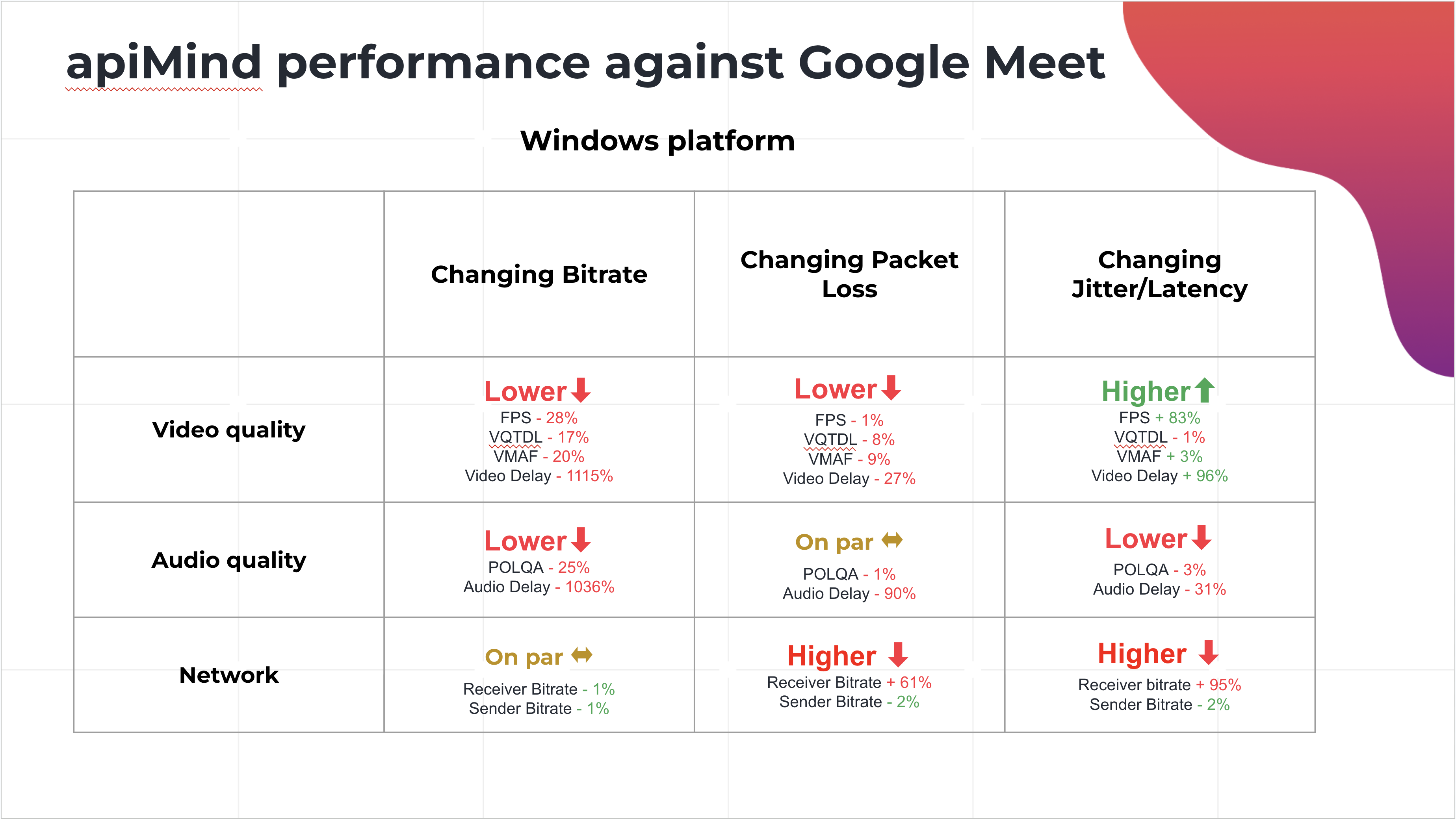
- Maintains functional video when Google Meet drops to 0.24 FPS and Jitsi disables video entirely
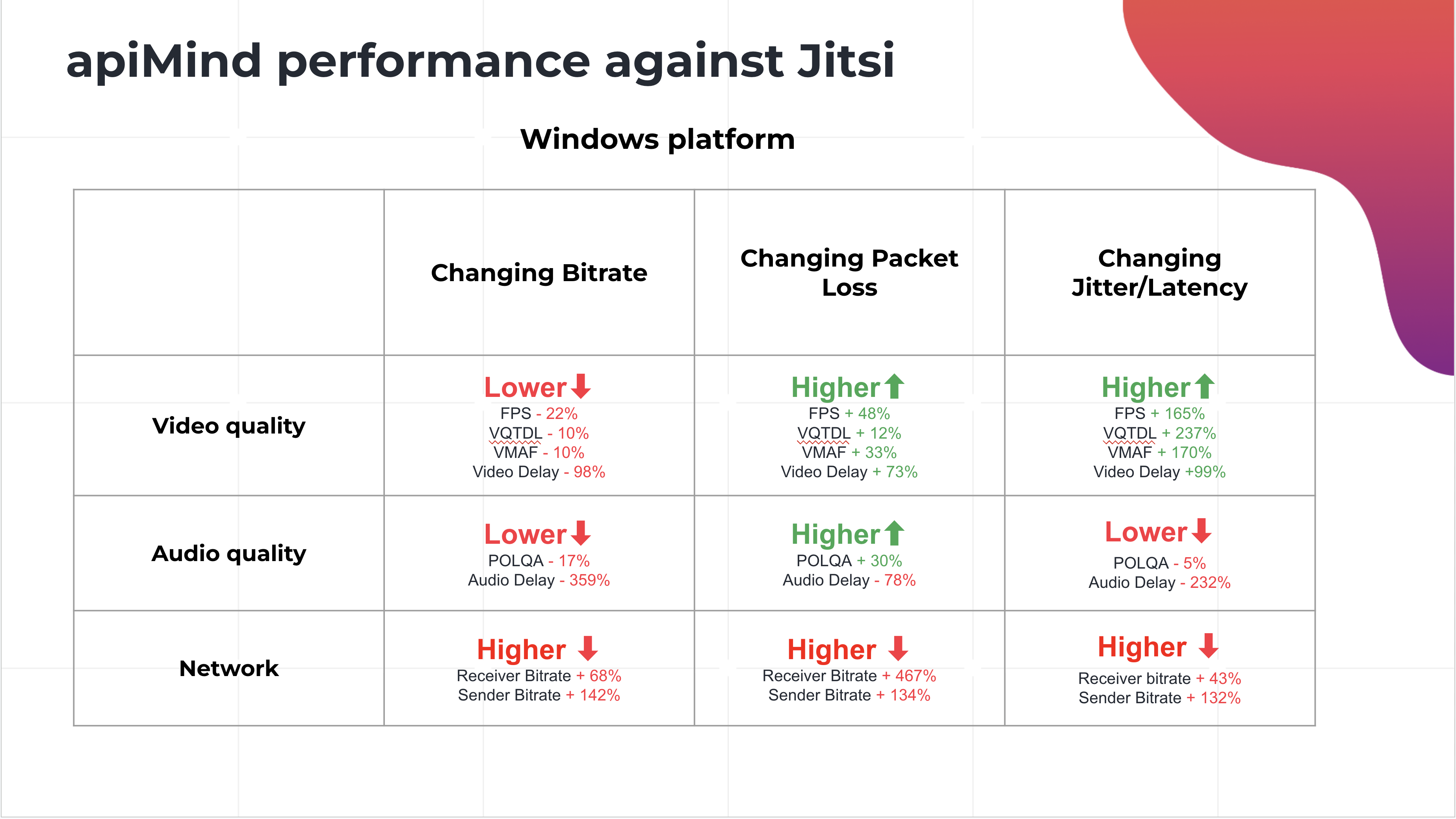
- +165% better FPS than Jitsi under high jitter/latency conditions
- Better video continuity compared to competitors in timing-sensitive scenarios
This is critical for users with unstable connections or those working through VPNs and remote locations.
Strong Packet Loss Handling
In packet loss scenarios (common in Wi-Fi networks):
- +48% better FPS than Jitsi
- +33% better video quality (VMAF) than Jitsi
- Comparable performance to Google Meet with minimal freezing
Optimized Network Utilization
apiMind demonstrates:
- Higher receiver bitrate on unlimited networks (optimized for quality when bandwidth allows)
- Efficient adaptation strategies in constrained environments
- Balanced resource allocation between audio and video
Areas for Improvement: We're Transparent
We openly acknowledge areas that need work:
- Low bandwidth adaptation (200kbps) — Currently experiencing audio drops and FPS degradation to ~5 FPS (Google Meet maintains ~17 FPS)
- Quality recovery after network improvement — System doesn't consistently return to original quality (50% recovery rate in tests)
- Baseline delays — Higher audio/video delays compared to competitors in optimal conditions
Year-Over-Year Progress: Measurable Improvements
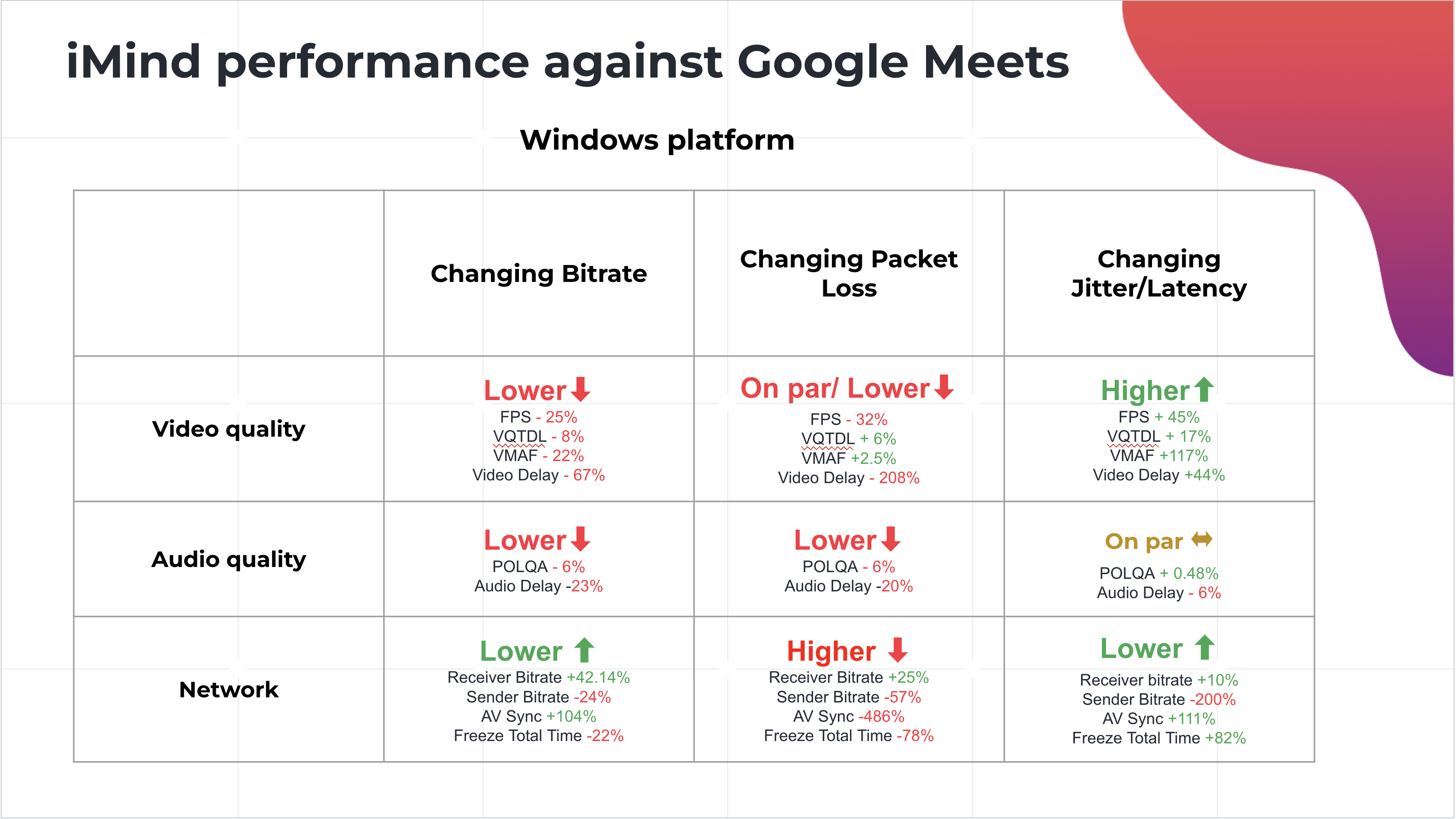
Comparing to 2023 results, we've achieved:
- Better stability during packet loss conditions
- Improved video quality at 20% packet loss
- Reduced baseline audio delay
- More consistent frame rate maintenance
Why This Matters for Our Users
For Enterprise Clients
- Resilience in challenging conditions: Maintains connection quality when network timing is inconsistent
- Predictable performance: Consistent behavior across different network scenarios
For Education
- Handles network instability: Better performance with jitter/latency common in institutional networks
- Maintains connection: Keeps video active when others might disconnect
For Remote Teams
- VPN-friendly: Superior handling of latency introduced by secure connections
- International calls: Better performance across long-distance connections with natural latency
Real-World Performance Context
Our optimization priorities reflect real usage patterns:
- apiMind excels when network timing is inconsistent (jitter/latency)
- Google Meet performs best with stable, high-bandwidth connections
- Jitsi offers open-source flexibility but may disable video under stress
Each platform has its strengths — we focus on maintaining communication when network conditions are unpredictable.
Our Development Roadmap
We're actively working on:
- Enhanced Bandwidth Adaptation — Improved audio prioritization and frame rate management at low bandwidth
- Dynamic Quality Recovery — Faster restoration to optimal quality when network conditions improve
- Latency Optimization — Reducing baseline delays while maintaining stability
Experience the Difference Yourself
Data tells a story, but your own experience writes the final chapter:
- Download the full test report - 2024 (90 pages of detailed metrics)
- Download the full test report - 2023 (85 pages of detailed metrics)
Conclusion
The independent benchmark provides valuable insights into real-world performance. apiMind shows strong performance in challenging network timing conditions and competitive packet loss handling, while we continue improving bandwidth adaptation and recovery mechanisms.
We're committed to transparency about both our strengths and areas for improvement. These results guide our development priorities as we build for real-world conditions.
Research conducted by TestDevLab (Latvia) in July 2024. Methodology: 3 participants, Windows/Chrome, testing under dynamic network conditions with each phase lasting 60 seconds — bandwidth (Unlimited→2M→500K→200K→500K→2M→Unlimited), packet loss (0%→10%→20%→20%→20%→10%→0%), and jitter/latency (0/0→100/30→500/90→1500/270→500/90→100/30→0/0 ms).
#apiMind #VideoConferencing #Benchmarking #RemoteWork #TechInnovation