
Real-Time Translation for E-Commerce: How to Enter the Global Market
A framework for using real-time AI translation to expand e-commerce internationally: how to read the market, where language barriers cost you sales, and what to measure in your own store instead of trusting borrowed numbers.
Real-Time Translation for E-Commerce: How to Enter the Global Market
A practical guide to international e-commerce expansion using AI translation: how to read the opportunity, where language barriers actually cost you sales, and what to measure in your own store instead of trusting borrowed numbers
Key Takeaways:
Cross-border e-commerce is large and growing faster than online retail overall. Shoppers consistently prefer to buy in their own language, and many simply won't buy from a store they can't read — so removing the language barrier is a real lever, not a nice-to-have. The size of that lever depends on your catalog, markets, and margins. Rather than repeating a percentage from someone else's study, this guide gives you a framework and tells you what to measure in your own store.
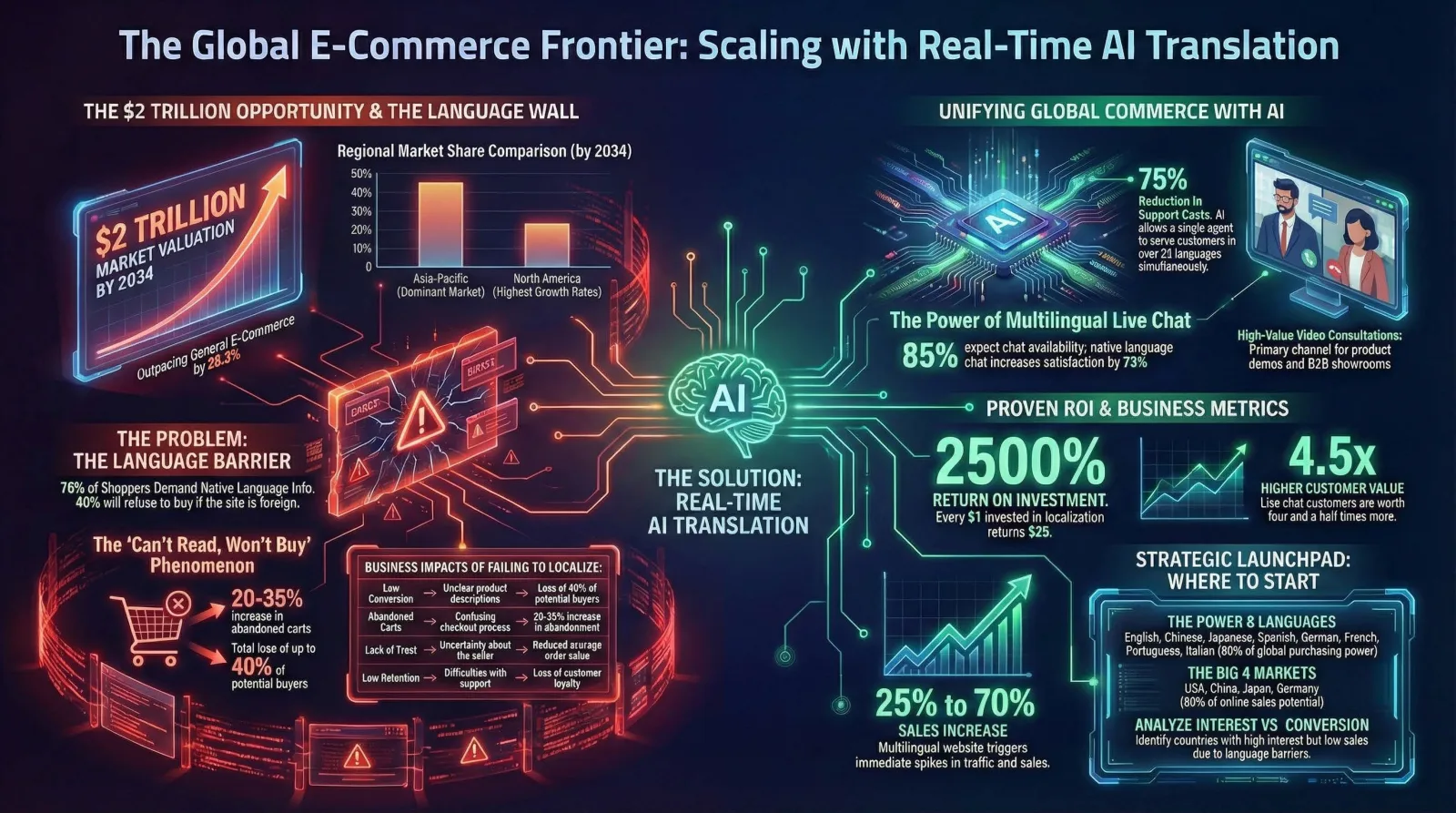
Scale of Opportunity: The Global Cross-Border E-Commerce Market
The global cross-border e-commerce market is large and growing quickly. Analyst forecasts vary widely by methodology, but they agree on the direction: cross-border trade is a meaningful and rising share of online sales, and it tends to grow faster than online retail overall. Treat any single dollar figure or growth rate you see (including in the reports below) as one firm's estimate of their defined market — not a fact about yours.
Direction is well supported across analyst reports (e.g. Precedence Research, Capital One Shopping); exact figures differ by source and definition, so we don't repeat a single one as fact.
A figure from someone else's study reflects their market, their year, and their methodology — not yours. We'd rather give you a framework than a percentage you take on faith. Wherever this post could quote a number, it instead tells you which metric to pull from your own store. That's the difference between marketing and measurement.
Regional Market Structure
Analysts broadly agree that the Asia-Pacific region leads cross-border e-commerce by volume, while North America is often cited among the faster-growing regions. Use this to prioritize, not to plan revenue — the shares below are directional, not precise.
Directional patterns reported across sources such as Market.us, eMarketer, and the World Bank. A figure from someone else's study reflects their market, not yours — check where your own traffic and demand actually come from.
Language Barrier: The Main Obstacle to Global Sales
Despite enormous opportunities, language barriers remain a critical obstacle to international expansion. CSA Research's widely-cited surveys ("Can't Read, Won't Buy") report a consistent pattern of buyer behavior — worth understanding qualitatively, then confirming against your own store's data.
The pattern above is reported by CSA Research's "Can't Read, Won't Buy" surveys. The exact percentages are theirs, measured across their respondent pool and markets — we describe the direction rather than repeat a number you'd take on faith. Verify accuracy, don't trust a number.
Business Consequences of Language Barriers
| Problem | Business Impact | Where It Shows Up — Measure It |
|---|---|---|
| Low Conversion | Customers don't understand product descriptions | Conversion rate on foreign-language traffic vs. your home market |
| Abandoned Carts | Confusing checkout process | Cart-abandonment rate segmented by shopper language/country |
| Lack of Trust | Customers unsure about the seller | Average order value and return rate in non-native-language markets |
| Repeat Purchases | Difficulties with support | Repeat-purchase and retention rate where support isn't in-language |
The point isn't a headline percentage — it's that each row is a metric you can already segment by language and country in your analytics. Pull those numbers for your own store; that gap is your real opportunity.
Why Real-Time AI Translation Is Critical
Traditionally, companies relied on static website translation, but modern e-commerce requires real-time communication: live chats, video consultations, and customer support.
🌐 Live Chat with Translation
Shoppers increasingly expect live chat, and satisfaction tends to rise when they can chat in their own language instead of struggling in a second one
💰 Support Cost Savings
One agent with AI translation can cover many languages at once, so you staff around demand instead of hiring a native speaker for every market
📈 Conversion Growth
Buyers lean toward a store they can read comfortably — sometimes even over a cheaper option they can't. Measure how much that's worth in your store
🎥 Video Consultations
Most business meetings now include remote participants across locations and languages. AI translation removes the language barrier from live calls
Directional observations consistent with reporting from LiveChat, Askly, Shopify, and Cisco. We'd rather give you a framework than a percentage you take on faith — the real numbers are the ones you measure.
Live Chat: The Maximum Conversion Point
Live chat is one of the more influential tools for increasing e-commerce sales. Vendor and industry reports point to a positive link between chat availability and revenue — the size of that link is exactly what you should measure in your own funnel rather than assume.
Directional signals from Freshworks, ICMI, and LiveChat reports. These are their environments, not yours — build the ROI yourself from your own numbers.
💵 Impact of Live Chat on Business Metrics
What the reports point to — and what to verify:
- ✅ Many companies report higher loyalty, sales, and revenue after adding chat — check the lift in yours
- ✅ Conversion often improves after chat implementation — measure your before/after
- ✅ Shoppers are more likely to return to a store that offers live chat
- ✅ Chat-engaged customers tend to be worth more than average — compare their AOV and lifetime value in your data
Directional, based on Kayako and ICMI reporting. Treat every claim here as a hypothesis to test on your own store, not a guaranteed result.
Localization ROI: Investments That Pay Off
Multiple studies point in the same direction — investing in language adaptation and real-time translation tends to pay off — but the headline ROI multiples you see quoted are model outputs built on specific assumptions. Use them to justify a test, not to promise a return.
💰 Return on Investment
Localization is frequently reported as strongly ROI-positive
Most companies that invest say it paid off — but the multiple depends entirely on your margins and markets
📈 Sales Growth
Multilingual and localized stores commonly see higher sales and traffic
How much is a function of your catalog and audience — measure the lift per market
⏱️ Long-Term Impact
Automating localization compounds over time as you add markets
Most companies report higher engagement once content is available in-language
Directional findings from Onesky.ai, Forrester Consulting, and Crowdin. A borrowed ROI multiple reflects someone else's cost base and catalog — build the ROI yourself with your own inputs, and it becomes a number you can actually defend.
Video Conferencing as a New Sales Channel
The global video conferencing market is large and expanding, and AI features are increasingly built into the major platforms. For e-commerce, this opens new opportunities for direct customer communication across languages.
| Signal | Direction | Source (their estimate) |
|---|---|---|
| Market Size | Large | Fortune Business Insights |
| Multi-Year Forecast | Growing | Fortune Business Insights |
| Annual Growth | Steady | Fortune Business Insights |
| Meetings with Remote Participants | Now the majority | Cisco Hybrid Work Index |
| Travel Cost Savings | Meaningful | SQ Magazine |
| AI Integration in Platforms | Rising fast | Cisco Annual Internet Report |
Each row links to a source's own estimate for its defined scope. We show direction rather than repeating precise figures that would read as facts about your business.
Opportunities for E-Commerce
- Video Consultations with Customers — Real-time product demonstrations
- Supplier Negotiations — Working with international partners
- Distributor Training — Onboarding across different countries
- Virtual Showrooms — Presentations for B2B clients
Practical Steps for Entering the Global Market
1. Market Prioritization
🌍 A Handful of Languages
A short list — English, Chinese, Japanese, Spanish, German, French, Portuguese, Italian — covers a large share of global online purchasing power. Start where the demand concentrates
🎯 A Few Large Markets
Markets like the USA, China, Japan, and Germany account for an outsized slice of global online sales. Prioritize by your own traffic, not a generic ranking
📊 Traffic Analysis
Use Google Analytics to find countries with high interest but low conversion — that gap is where in-language experience likely pays off first
The "concentration" pattern is widely reported (e.g. Translated.com); the exact coverage share depends on how you define purchasing power. Let your own analytics pick the order.
2. Implementing Real-Time Translation
💬 Live Chat with AI Translation
Automatic customer language detection. Real-time translation. One agent — the entire world.
🎥 Video Consultations
Simultaneous translation for premium product sales and B2B negotiations.
📞 Customer Support
Most customers strongly prefer receiving support in their native language — in-language support reduces friction and repeat contacts.
📝 Documentation
Automatic subtitles and transcripts for consultation recordings.
3. Measuring Results
📈 Conversion
😊 CSAT
💵 Revenue/Chat Hour
🔄 Retention
Conclusion: Time to Act
The cross-border e-commerce market is growing faster than online retail overall. Meanwhile, many non-native English speakers prefer content in their own language even when they read English well — fluency doesn't erase the preference to buy in the language you think in. The opportunity is real; the exact size of it is something you measure in your own store, not something you inherit from a slide.
Ready to Enter the Global Market?
Test our video conferencing platform with integrated real-time AI interpretation in 15+ languages. Conduct global trainings without language barriers.
First 25 meetings free — no credit card required