
AI Interpretation for Employee Training — Build the Case, Don't Borrow It
Real-time AI interpretation can make multilingual training work — but not because of a headline percentage. Here's a practical, verifiable framework for measuring it on your own team.
AI Interpretation for Employee Training — Build the Case, Don't Borrow It
A practical guide to real-time AI interpretation in corporate training for multilingual teams — where the value actually sits, and how to measure it on your own data
Executive Summary:
When you train a global workforce, some of your people are learning in a language that isn't their first. Real-time AI interpretation can close that gap in live training and onboarding. But whether it pays off in your organization is a question you answer with a pilot and your own metrics — not with a percentage from someone else's case study. This is the honest version: where the value shows up, where the costs sit, and how to build a return figure you can actually defend.
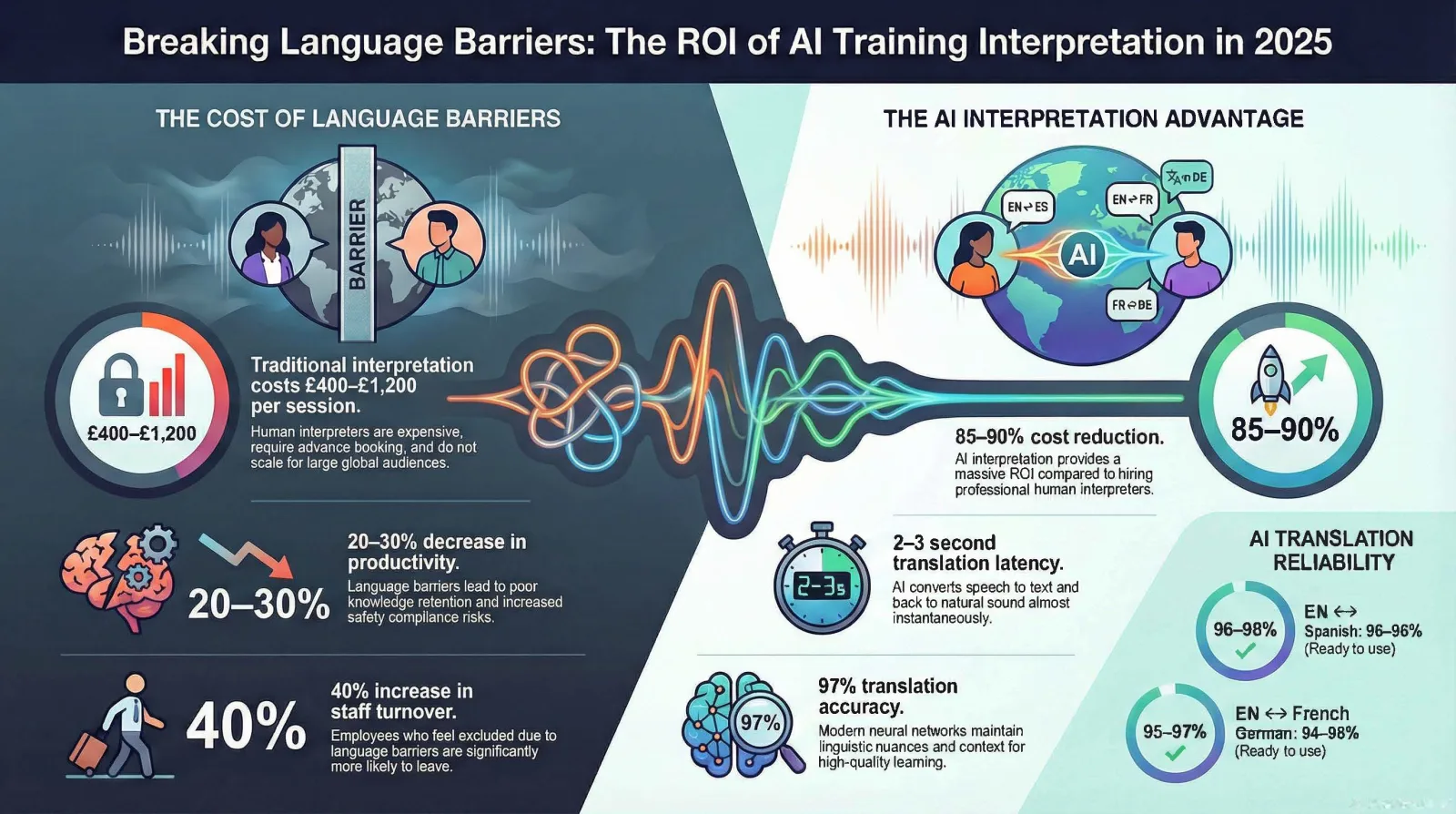
Why a headline number won't justify your budget
There's no shortage of impressive statistics about corporate training and AI translation — cost reductions, accuracy scores, revenue-per-employee lifts. They make good slides and bad decisions. A figure from someone else's study reflects their workforce, their content, their language mix, and their cost base — not yours.
At Mind.com — the company behind InterMIND — we'd rather give you a framework you can run on your own data than a percentage you have to take on faith. So the rest of this article does two things: it names the places where multilingual training value tends to appear, and it gives you a way to measure whether it appears for you.
Where the value really shows up
The case for interpreting training into people's own language is strong — but it's qualitative until you put your own numbers behind it. The value tends to appear in a few recurring places. Treat each one as a place to measure, not a number to quote.
- Reach for non-native learners. Anyone who currently absorbs training in a second or third language is doing extra cognitive work just to keep up. Deliver the same session in their language and comprehension improves — the question is by how much, for your content and your language pairs.
- Fewer misunderstandings in high-stakes training. Safety, compliance, and regulatory content is exactly where a missed nuance is expensive. Removing the language barrier removes a category of failure, not just friction.
- Engagement and retention. People who can follow, question, and contribute in their own language tend to stay more engaged — and engagement in development tends to show up downstream in retention.
- Access for distributed teams. Live multilingual delivery lets a single session reach a geographically and linguistically split workforce, instead of duplicating trainers, sessions, or materials per language.
Notice that none of these is a universal percentage. Each is a hypothesis you can test on your own baseline.
Where the costs sit
A defensible case is honest about cost. For most organizations the line items are:
- Technology / platform — the interpretation capability itself.
- Human review for high-stakes content — for safety and regulated training, machine output is a first pass, not the final word. Budget for a human in the loop where the cost of an error is high.
- Integration and staff enablement — wiring it into your training stack and getting trainers and learners comfortable with it.
- Terminology upkeep — keeping your product names, acronyms, and industry vocabulary rendered correctly over time. This is recurring, not one-off, and it's the line most plans underestimate.
The right magnitude depends on your size and scope, so resist plugging in someone else's dollar figures. The point of listing these is to make sure none gets quietly left out of your own estimate.
How to build a case you can actually defend
Instead of importing a result, produce your own:
- Set a baseline. Measure today's state for the training that matters — completion rates for your non-native segments, time-to-productivity for new hires, error or rework rates after training, assessment scores broken out by language.
- Pick one or two metrics. Don't try to capture everything. Choose the one or two outcomes most tied to productivity or risk in your context.
- Run a scoped pilot. Start with your highest-impact training — often safety, compliance, or onboarding — and your top one or two language pairs. Keep it small enough to measure cleanly.
- Measure before and after. The delta on your own baseline is your evidence — and unlike a borrowed percentage, you can defend it line by line.
- Compute your return, then scale what works. Now the number means something, because it came from your data.
This is slower than quoting a study. It's also the only version that survives scrutiny when finance pushes back.
What to measure — and where to look
You don't need invented figures to know which signals are worth tracking. Instrument the ones tied to your baseline and watch how the pilot moves them.
📊 Completion rate
📝 Assessment scores
⏱️ Time to productivity
🔁 Errors / rework
😊 Learner satisfaction
The point isn't to hit a target someone else published. It's to see whether your non-native segment closes the gap on your native one once the language barrier is removed.
Be honest about the limits
Real-time AI interpretation is genuinely useful, but it isn't uniform quality across every language and every topic, and pretending otherwise sets a pilot up to fail.
- Quality depends on the language pair and the subject matter. High-resource pairs and well-structured content are handled well; lower-resource pairs and dense, jargon-heavy material are harder. An "average accuracy" figure hides exactly the pair you care about — so don't buy on one. See how to actually verify translation accuracy instead of trusting a headline percentage.
- High-stakes content needs a human in the loop. For safety and regulatory training, treat machine interpretation as a first pass and keep human review where a mistranslation carries real consequences.
- Custom terminology matters. Out of the box, a model won't know your product names, acronyms, or internal shorthand. A glossary you control is what keeps your terms rendered correctly.
And on the money side: the return figure you should trust is the one you measured, not the one you inherited. If you want the general version of that argument, we wrote it up separately — build the ROI number, don't borrow it.
Where InterMIND fits
A lot of training value lives in live delivery — the onboarding session, the safety briefing, the product rollout — where there's no time to send a script out for translation first. That's the problem InterMIND is built for: real-time multilingual meetings and training where each participant hears the session in their own language as it happens, with tone and intent intact.
For training programs where the case is driven by risk and compliance, the parts that make a return defensible are the same parts we make checkable:
- Custom glossaries so your corporate and industry terminology is rendered the way you require.
- An audit trail so what was communicated can be reviewed after the fact — often a hard requirement in regulated sectors.
- Live multilingual onboarding and training so a single session reaches a distributed, multilingual workforce without duplicating it per language.
The most useful figure for AI interpretation in training is the one you measured on your own team. We'd rather help you build that than hand you ours — see how InterMIND supports live multilingual training at intermind.com.
Ready to test it on your own training?
Run a scoped pilot on your highest-impact training with real-time AI interpretation. Bring your own baseline — and measure the difference for yourself.
First 25 meetings free — no credit card required