
The Global Language: From Latin to Artificial Intelligence
A history of the lingua franca — from Aramaic to English — and why AI translation may change the very idea of a 'world language' in 2025 and beyond.
The Global Language: From Latin to Artificial Intelligence
How humanity's lingua franca has evolved throughout history — and why AI translation may render the very concept of a "world language" obsolete
Executive Summary:
For millennia, humans have sought ways to overcome language barriers. Today, we stand on the brink of a shift: AI translation technologies could make the very institution of a single global language less necessary. English currently dominates international communication — most of its speakers learned it as a second language, and it is the default in international organizations, on the web, and in science. Meanwhile, the machine translation market is growing quickly. This article traces the evolution of global languages from Aramaic to English — and explores what comes next.
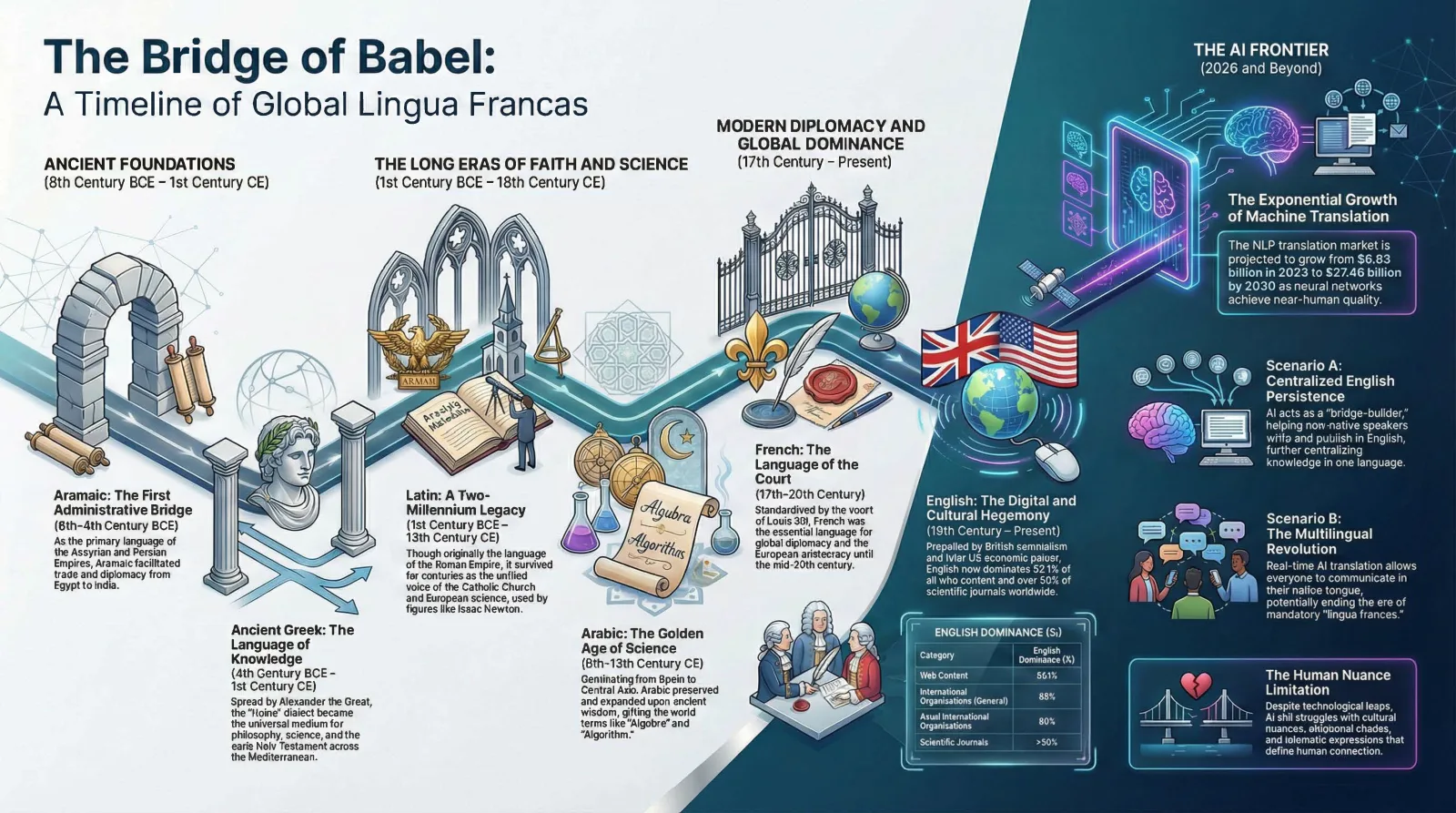
The Evolution of Global Languages: A Historical Overview
Throughout history, the rise and fall of lingua francas has followed a consistent pattern: languages of power become languages of communication. From ancient empires to modern technology, each global language reflects the geopolitical reality of its era.
Aramaic: The First Global Language (8th–4th Century BCE)
The history of global languages begins not with English, nor even with Latin. Aramaic became the first truly international language during the 8th to 4th century BCE, during the Assyrian and Persian empires. It served as the language of trade and diplomacy across a vast territory stretching from Egypt to India. Jesus Christ spoke Aramaic, and the language survives to this day in some Middle Eastern communities.
Why Aramaic? The answer is simple: it was the language of those who held political and economic power. The Persian Achaemenid Empire spanned enormous territories, and Aramaic served as the administrative language connecting its numerous peoples.
Ancient Greek: The Language of Knowledge (4th Century BCE–1st Century CE)
The conquests of Alexander the Great in 336–323 BCE brought Ancient Greek to territories stretching from Greece to India. Greek — specifically its spoken form Koine — became the language of education, philosophy, and science throughout the Hellenistic period and early Roman times. Hellenistic culture spread across the Mediterranean, and even after Alexander's empire fell, Greek retained its status as the language of the intellectual elite.
Notably, the New Testament was written in Koine Greek, even though Jesus and his disciples spoke Aramaic — the authors chose Greek so their texts could be read by people throughout the Mediterranean world.
Latin: Two Millennia of Dominance (1st Century BCE–18th Century)
Latin became the lingua franca of the Roman Empire starting around the 1st century BCE and maintained this status for nearly two millennia. However, it's important to understand that even at Rome's peak, Latin remained a minority language within the empire itself. Most of the population spoke local languages, while Latin was used in administration, law, and official correspondence.
After the fall of the Western Roman Empire, Latin didn't disappear — it transformed into the language of the Catholic Church, science, and education. Scholars from Ireland to Poland wrote their works in Latin until the 18th century. Isaac Newton published his "Principia Mathematica" (1687) in Latin.
Arabic: Language of the Scientific Golden Age (8th–13th Century)
During the Islamic Golden Age (8th–13th century), Arabic became the lingua franca of a vast region stretching from Spain to Central Asia. It was not only a language of religion but also of science: works of ancient philosophers were translated into Arabic, preserved, and expanded by Arab scholars. Words like "algebra," "algorithm," and "alchemy" remind us of this heritage.
French: The Language of Diplomacy (17th–20th Century)
In the 17th–19th centuries, French assumed the position of the primary language of international diplomacy. The court of Louis XIV at Versailles (reign 1643–1715) set the tone for European culture, and knowledge of French became mandatory for aristocrats from Lisbon to St. Petersburg. Even Russian nobility preferred speaking French — recall the characters in Tolstoy's "War and Peace."
French remained the official language of diplomacy until the mid-20th century: the Treaty of Versailles in 1919 was drafted in both French and English, marking the first recognition of equality between these languages on the international stage.
English: The First Truly Global Language (19th Century–Present)
English represents a unique phenomenon in human history. No language has ever achieved such a level of spread and influence. According to Ethnologue, English is spoken by well over a billion people — yet the majority learned it as a second language rather than from birth. For every native English speaker, there are several more people who acquired it deliberately.
How English Became Global
English's rise to world language status occurred in two stages.
Stage One: The British Empire. By the end of the 19th century, the British Empire encompassed a quarter of Earth's land surface. English became the administrative language in India, Africa, Australia, and North America. Nearly 60 countries today recognize English as an official language — a direct legacy of the colonial period.
Stage Two: American dominance in the 20th century. After World War II, the United States became the leading economic, military, and cultural force on the planet. Hollywood, rock and roll, then Silicon Valley and the internet cemented English's position as the language of global culture and technology.
English by the Numbers
Directional picture, not precise measurement. Sources: Ethnologue; W3Techs (web-content language share).
English has truly become the first language that can be called global in the fullest sense. Neither Latin nor French ever achieved such reach.
The Unique Structure of English: A Language of Non-Native Speakers
English is unique in that the majority of its speakers are people for whom it is not their native language. That is what sets it apart from the other giants:
| Language | Where its speakers come from |
|---|---|
| 🇬🇧 English | Mostly second-language learners; native speakers are a minority |
| 🇨🇳 Mandarin Chinese | Overwhelmingly native speakers, concentrated in the Chinese-speaking world |
| 🇪🇸 Spanish | Overwhelmingly native speakers across the Americas and Spain |
| 🇮🇳 Hindi | A large native base plus many second-language speakers across India |
| 🇫🇷 French | A relatively small native base extended by learners worldwide |
Illustrative comparison of how each language's speaker base is composed, not exact counts. Source: Ethnologue.
This explains a key distinction: Spanish and Chinese are languages of enormous demographic blocs, while English is a language of global communication that people learn deliberately.
The Paradox of Native English Speakers: Monolingualism
Another paradox: native English speakers are among the least multilingual people in the world.
🇺🇸 United States
Only a minority of the population reports speaking a second language
🇬🇧 United Kingdom
Foreign-language ability is uncommon, and most young people are effectively monolingual
🇪🇺 European Union
Most adults know at least one foreign language, per the EU's own surveys
🇸🇪 Nordic Countries
Near-universally multilingual in practice, especially among younger generations
Directional, not exact. The broad pattern is well documented by the EU's Eurobarometer language surveys; treat the country-by-country contrasts as qualitative.
Native English speakers don't learn other languages because the entire world learns their language. This creates an asymmetry: for international communication, non-English speakers bear all the cognitive burden.
Challenges to English Dominance
Despite its obvious leadership, English's position is not unassailable. Two factors may change the linguistic map of the world.
The Rise of China and Mandarin
Mandarin Chinese is the language with the most native speakers in the world. China's economic rise stimulates interest in learning it: by various estimates, many millions of people outside China are studying Mandarin.
China has also invested heavily in promoting the language abroad through its network of Confucius Institutes, and countries such as Saudi Arabia have begun offering Mandarin as an elective in schools. The number of learners has been growing.
However, Mandarin has structural limitations. Its speakers are overwhelmingly native, meaning relatively limited spread outside the Chinese-speaking world. The complex writing system (characters) and tonal nature create a high barrier to entry for learners.
As Clayton Dube of the USC U.S.-China Institute noted: "As China rises you can anticipate that more people will adopt the language. But is China going to replace English? I don't think so — certainly not in my lifetime, probably not in the next two, three, four generations."
The Technological Revolution: AI Translation
A more serious challenge to the very concept of a global language comes from artificial intelligence technologies.
AI Translation: The End of the Lingua Franca Era?
The machine translation market is experiencing explosive growth.
Market-size forecasts vary widely between analysts; the direction of travel is clearer than any single number. Figures above are qualitative.
What Can Modern AI Translation Do?
Neural machine translation (NMT) has made a qualitative leap in recent years:
📊 Scale
A vast share of global digital content still needs localization — AI makes that feasible at a scale human translation alone never could
🤖 Customer Support
Real-time translation is increasingly built into how global companies handle customer support
⚡ Speed
Low enough latency for near-real-time speech translation in a live conversation
🎯 Accuracy
Strong results for major language pairs — though quality varies by language and context, and headline accuracy claims deserve scrutiny. See how to actually measure translation quality.
Two Possible Futures
Researchers from the University of Queensland, in a paper published in PLOS Biology in June 2025, describe two possible scenarios for the future of academic (and, more broadly, all) communication:
🌐 Scenario 1: English Remains Lingua Franca
International journals continue to publish in English, but researchers with limited language proficiency write in their native language and use AI for translation. AI also helps read, review, and edit English-language papers. Knowledge continues to centralize around English, but AI lowers access barriers.
🗣️ Scenario 2: A Multilingual World
Everyone writes, reads, and reviews in their native language. AI performs real-time translation between any language pairs. English loses its status as the sole language of international communication. Knowledge decentralizes.
How AI Translation Will Change the World
If synchronous AI translation technologies achieve quality comparable to human translation, the consequences will affect all spheres of life.
Business and Trade
Language barriers have historically limited international trade. Companies were forced to hire translators, localize products, and train employees in foreign languages. AI translation radically reduces these costs.
Imagine a video conference where each participant speaks their native language, and AI instantly translates speech for all others. This is not a futuristic fantasy — this is today's reality.
Education and Science
The dominance of English in science creates serious barriers. Researchers from non-English-speaking countries spend more time preparing publications, their work is cited less frequently, and knowledge published in other languages remains invisible to the international community.
📚 The Education Gap
UNESCO has repeatedly warned that a large share of people worldwide lack access to education in their native language, with the gap widest in lower-income countries. AI translation could help democratize access to knowledge on a global scale.
Cultural Diversity
Paradoxically, technologies created primarily in English can both threaten and protect linguistic diversity.
On one hand, large language models (LLMs) are trained predominantly on English content, reinforcing English's dominance in the digital environment. On the other hand, the development of multilingual AI could give new life to smaller languages.
Industry watchers expect coverage of rarer languages to keep expanding, with growing attention to the languages of Africa, Southeast Asia, and South America that have historically been underserved by translation tools.
What Will Remain of Languages in the AI Era?
Does all this mean that learning foreign languages will become pointless? Not quite.
AI translation, for all its achievements, is still unable to fully convey cultural nuances, idiomatic expressions, and emotional undertones. A study published in the International Journal of Applied Linguistics and Translation in June 2025 emphasizes: "AI excels at processing large volumes of text and expanding language coverage, but often lacks the ability to fully grasp contextual meanings, cultural subtleties, and ethical implications."
Language is not merely a tool for transmitting information. It is a way of thinking, a window into culture, a means of building relationships. Knowing your interlocutor's language creates trust and depth of communication that no translation can provide — yet.
As Clayton Dube noted: "To speak Chinese means you begin to think as Chinese people do. You begin to understand how Chinese speakers have the world organized, how they perceive things. And that is a vital step if you're going to be culturally competent."
Conclusion: End of an Era or a New Beginning?
The history of global languages is a history of power, trade, and cultural influence. Aramaic, Greek, Latin, Arabic, French, English — each of these languages reflected the geopolitical reality of its time.
English became the first truly global language thanks to a unique combination of factors: British colonialism, American economic and cultural dominance, the Industrial Revolution, and the internet. Today more than a billion people speak it, and it dominates science, business, technology, and entertainment.
But we are at a turning point. AI translation is developing rapidly. The market is growing quickly, quality is improving, and costs are falling — though, as with any fast-moving technology, the honest claims are the ones you can actually measure.
Perhaps we will be the last generation for whom learning English is a mandatory condition for an international career. Perhaps our children will live in a world where everyone speaks their native language, and technology does the rest.
But this is not the end of the story of languages — it is a new chapter. Languages will live, evolve, and carry the cultural heritage of peoples. It's just that their function as lingua franca may pass to machines.